
I recently traveled to SF to give a talk at Agency School, “a gathering for people who want to learn how to take action” as it said on its landing page. This piece is a version of a talk that I gave there. The talk was inspired by Peter Limberger’s writings on high agency and wise agency.
The way I understand high agency is the ability to just do things. Someone who saw something they wanted to accomplish, decided to do it, took the necessary actions to get it done, and was successful. Many of the people we admire have this powerful trait. I felt this kind of agency down to my aching bones when I finished my first half marathon. “Wow, I just did that. I woke up this morning and ran 13 miles.”
But the danger Limberger points out is that high agency is only concerned with asking, how far can my agency take me? It doesn’t have time to ask: is this the right way I should be going?
Wise agency is concerned with that second, less efficient question: is all this work I’m doing the right thing for me to do? I was faced with answering this for myself as 2020 started, wondering if the ten plus years of agency towards being a full-time photographer was what I should keep doing. I was terrified it wasn’t true. My identity, livelihood, reputation, skill were wrapped up in this one pursuit that I didn’t feel excited about anymore. When the lockdown happened in the middle of March, I lost my entire business for that year. There was nothing left for me to do. All that agency had to sit still with what happened and listen to what was next.
During that time, there was a quote from Frederick Buechner that became a north star for me:
“The place God calls you to is the place where your deep gladness and the world’s deep hunger meet.”
I couldn’t name it then, but what I needed was my agency to become wiser. And I wasn’t going to have it by searching and striving, but by listening. That place where my gladness and the world’s hunger meet is a place I’m called to. A call given by something or someone outside of myself.
Limberger traces this kind of attunement to the Taoists, the Stoics, and the early Christians. They all came to the same conclusion that wise action comes from alignment with what the Taoists called the Tao, the Stoics called Logos, the early Christians called God. The Christian wisdom tradition calls it synergeia, or cooperation with God.
In Matthew 6, Jesus gives this distinction its deepest grounding: what high agency and wise agency look like, what it looks like to be the second kind.
“When you pray, don’t be like hypocrites. They love to pray standing in the synagogues and on the street corners so that people will see them. I assure you, that’s the only reward they’ll get. But when you pray, go to your room, shut the door, and pray to your Father who is present in that secret place. Your Father who sees what you do in secret will reward you.”
The hypocrites he mentioned were the Pharisees, who were the religious elite of the time. And in Jewish society, where religious authority was the highest authority, that made them the most powerful, most influential people in their world. They were the most agentic. They were the most educated, most devoted, and everyone looked up to them.
And Jesus calls them hypocrites! That word in the original text literally means a mask. Like an actor wearing a mask to perform a role. I don’t think his accusation was just that they were duplicitous, like how we understand the word now. It was that they did all this hard work but they weren’t really being themselves. They had lost who they were and so their lives were just a performance, and the only thing that made it worth it was applause from the crowd. And that’s all they were rewarded with, nothing more. He’s saying don’t be like them because their lives are tragic.
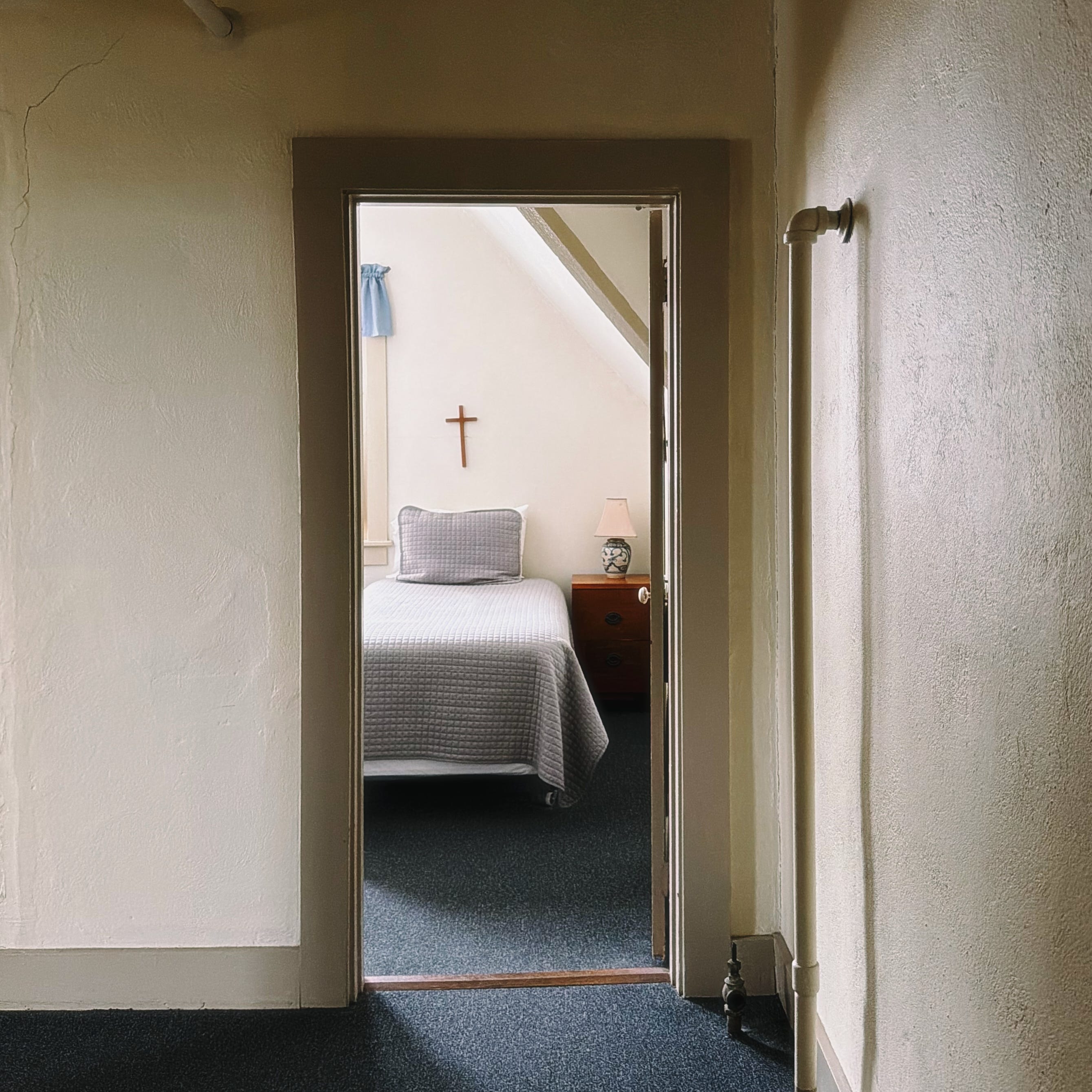
Jesus says instead, go to your room, shut the door, pray in secret; the complete opposite of how the Pharisees were praying. The word for room meant the innermost room of a house, the one that was the most private space you had. But the people listening would have understood this inner room as more than just a physical space, but an interior one. The room of the heart. And God is the one waiting there.
Julian of Norwich, a 14th century English mystic, names reward this way:
“All shall be well, and all shall be well, and all manner of thing shall be well.
For I saw truly that before God created us, He loved us, which love was never lacking and never shall be.
In this love all our life is grounded, and in this love we are kept, and this love shall never be broken in us.
Therefore, when we fall into any distress or confusion, it is God’s will that we turn our eyes to Him gently, trusting that all shall be made whole, and all manner of thing shall be well.”
Love. That was her reward, and it’s also mine. A love that was there before I was created. A love that’s never lacking. A love that grounds my life and is never broken within me.
And when I go to that secret inner room, I turn to Him. Gently. Not performing, not hustling, not earning. I spent years doing just that, but all He asks is, “Be still and know that I am God.”
I think that surrender and receiving is what cooperation with God feels like, moment by moment. My desires, needs, and agency being met with, “Be still, turn your eyes to Me, accept my love and trust that all will be well.” And in that meeting, wisdom meets my agency through love and grace.
Later in Matthew 6, Jesus turns from secret prayer to freedom from fear about the future. He points to the birds and the lilies who don’t sow or reap or toil, but God feeds and provides for them. There was a lot of fear and worry in me in 2020 and the years that followed. So much was taken away from me, that I couldn’t see what my future was like. I wrote about this last year:
I think the lilies figured out something that’s taken me a long, long time to realize: their only focus is to be who they were created to be. Nothing more, nothing less. And their Creator, a good God, provides for them to keep being who they were created to be. This simple unfolding is held together by an all-powerful, all-loving God. And year after year, again and again, they blanket the field with their beautiful blossoms.
I had to take off a lot of masks before I could even find my inner room. In cooperation I hear His call to the place where my deep gladness and the world’s deep hunger meet. But I don’t think that place is somewhere static. I don’t think it can be found. Only unfolded.
Beautiful Minnow... you're bringing me closer to understanding 'agency'.
I love this so much Minnow! Your writing, your heart and courage to go even deeper have been such an inspiration to me over the years.
I remember that day in March 2020- all too well. And you were the reason I was able to publish my first book and continue to have hope for the future when my mom died of COVID that month and my business stopped in its tracks. By God’s grace- I’m still here, like the lilies of the field and yet I’m still relearning what that means. Coming here to Substack after wandering in the desert for what feels like 40 years has felt like finding an oasis. Thank you for writing and for encouraging me- I have seen the imago dei in you and I am forever grateful. 🫶🏻